



How AI Datasets Are Used in Healthcare AI
Artificial Intelligence is rapidly transforming the healthcare industry. From early disease detection to intelligent medical chatbots, AI is helping doctors make faster and more accurate decisions.
However, behind every successful healthcare AI system lies one critical foundation: high-quality AI datasets.
AI models do not automatically understand medical images, clinical notes, or patient conversations. They must first be trained using carefully curated and annotated datasets created by human experts.
In this article, we explore how AI datasets are used in healthcare AI and why data quality is crucial for building reliable medical AI systems.
Why Healthcare AI Needs High-Quality Datasets
Healthcare is one of the most sensitive and complex industries. AI models must achieve extremely high accuracy because mistakes can directly impact patient care.
To achieve this accuracy, AI systems must learn from large volumes of structured and annotated healthcare data, such as:
Medical images
Clinical records
Patient conversations
Diagnostic reports
Sensor and wearable data
These datasets allow machine learning models to recognize patterns, detect anomalies, and assist medical professionals in decision-making.
Key Types of Healthcare AI Datasets
1. Medical Imaging Datasets
Medical imaging is one of the most widely used areas of healthcare AI.
AI models are trained using annotated images such as:
X-rays
CT scans
MRI scans
Ultrasound images
Data annotators label important structures or abnormalities, including:
Tumors
Fractures
Lesions
Organ boundaries
This annotated data helps AI systems detect diseases faster and support radiologists in diagnosis.
2. Clinical Text Datasets
Healthcare systems generate large volumes of unstructured text, including:
Doctor notes
Electronic health records (EHR)
Medical reports
Discharge summaries
Through text annotation and dataset curation, these documents are converted into structured training data for Natural Language Processing (NLP) models.
Healthcare NLP systems can then perform tasks such as:
Medical entity recognition
Clinical document classification
Patient risk prediction
3. Conversational Healthcare Data
Healthcare chatbots and virtual assistants require large datasets of patient conversations.
These datasets include:
Patient questions
Doctor responses
Symptom descriptions
Appointment queries
Annotated conversational datasets allow AI systems to understand medical queries and provide helpful responses while directing patients to the appropriate healthcare resources.
4. Wearable and Sensor Data
Modern healthcare increasingly relies on wearable devices and remote monitoring systems.
AI datasets collected from these sources include:
Heart rate data
Sleep patterns
Blood oxygen levels
Activity tracking
Machine learning models analyze these datasets to detect early warning signs of health issues and enable proactive care.
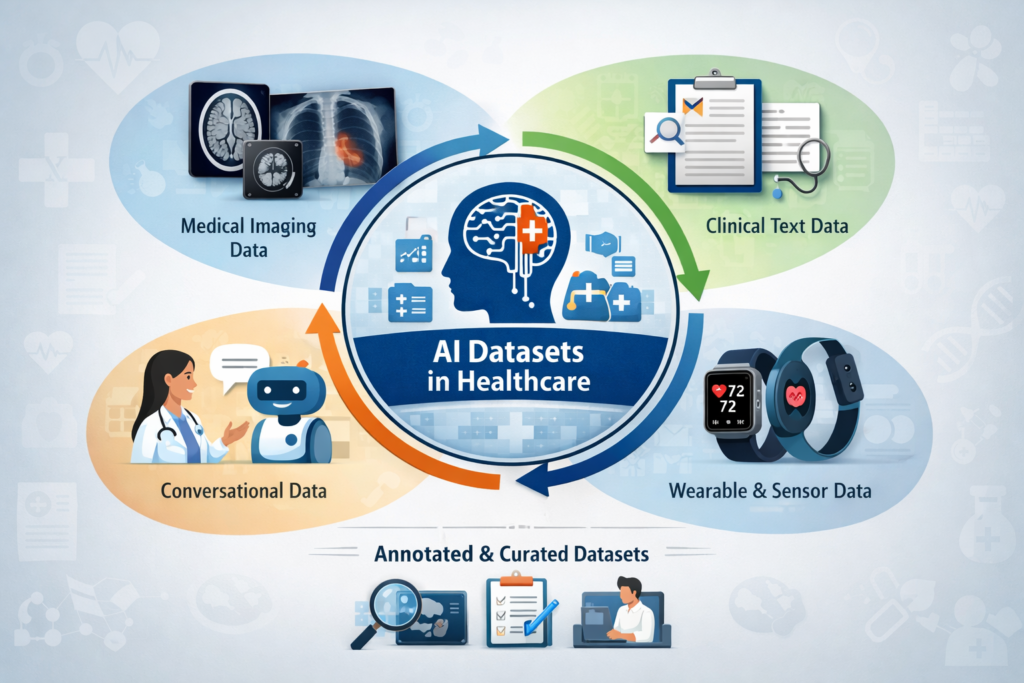
The Role of Data Annotation in Healthcare AI
Raw medical data alone is not sufficient for training AI systems.
Before training begins, datasets must undergo data annotation and validation to ensure the AI model learns the correct patterns.
Common healthcare annotation tasks include:
Medical image segmentation
Bounding box labeling of abnormalities
Named entity recognition in clinical text
Intent labeling for healthcare chatbots
Because healthcare AI requires extremely high accuracy, annotation is often performed with strict quality control and expert validation.
Challenges in Healthcare AI Dataset Creation
Building healthcare AI datasets is more complex than standard data annotation projects.
Key challenges include:
Data Privacy Regulations
Healthcare data must comply with strict regulations such as HIPAA and other privacy frameworks.
Domain Expertise
Medical datasets often require annotation by trained professionals who understand medical terminology and imaging.
Data Diversity
Healthcare AI must work across diverse patient populations, requiring datasets that represent different demographics and conditions.
Why Quality Datasets Determine AI Success
The performance of any AI system depends heavily on the quality of the data used to train it.
Poor datasets can lead to:
Incorrect diagnoses
Biased predictions
Unreliable AI recommendations
On the other hand, well-curated and validated datasets enable healthcare AI systems to achieve higher accuracy, reliability, and safety.
Conclusion
Healthcare AI has the potential to transform medical diagnosis, patient care, and healthcare efficiency. But none of this is possible without high-quality training data.
From medical image annotation to clinical text processing, AI datasets form the backbone of modern healthcare AI systems.
Organizations that invest in high-quality dataset creation, annotation, and validation will be better positioned to build reliable AI solutions that truly improve healthcare outcomes.
Dserve AI specializes in healthcare AI dataset creation, medical data annotation, and large-scale AI training data services to support advanced machine learning applications.
Visit: https://dserveai.com/