


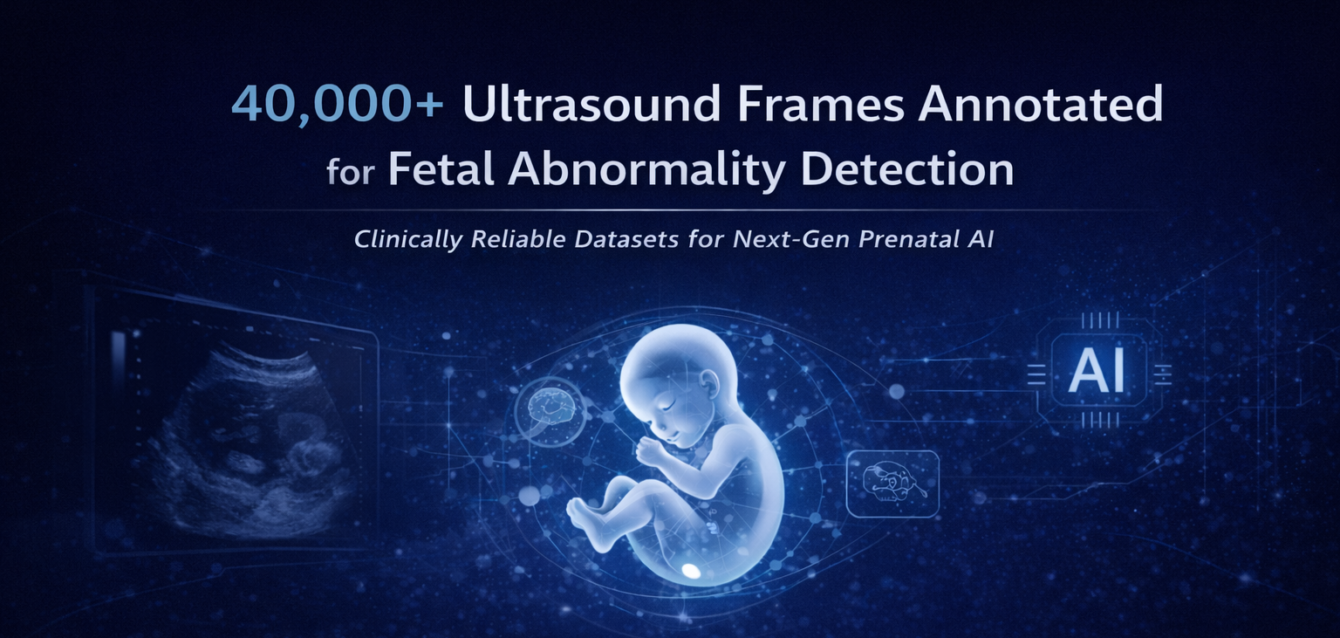
40,000+ Ultrasound Frames Annotated for Fetal Abnormality Detection
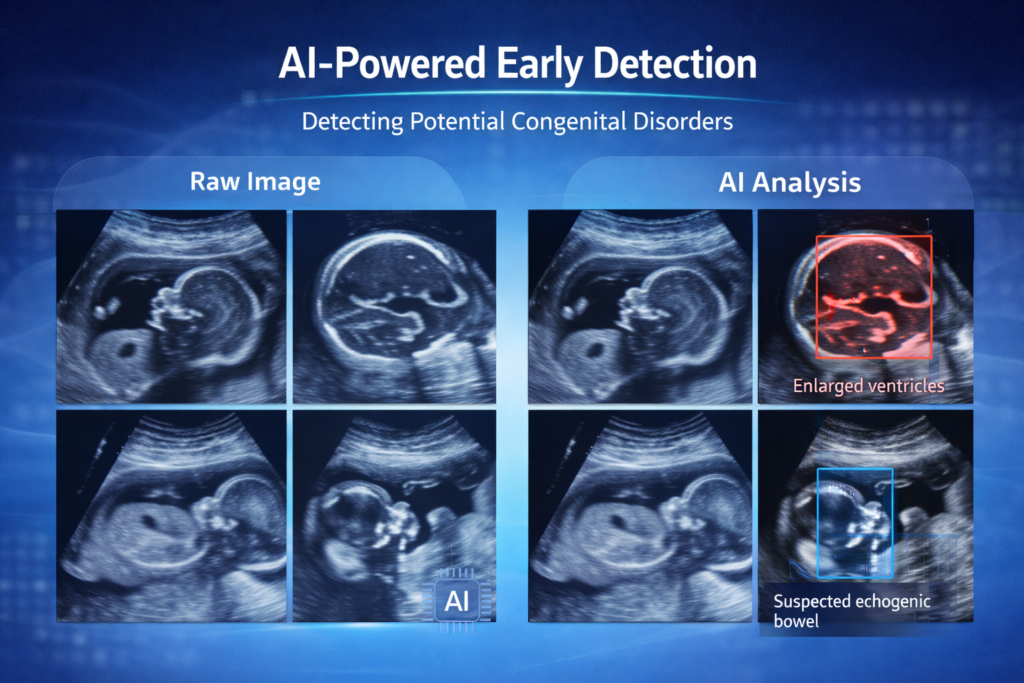
The client is a healthcare AI innovator developing a cloud-based prenatal screening platform used by radiologists and obstetricians to detect fetal abnormalities from ultrasound imaging. Their product aimed to support early-stage detection of congenital disorders across diverse hospital environments.
Despite collecting thousands of ultrasound images, the client struggled to transform raw medical data into a usable training dataset that could consistently perform across gestational stages, patient demographics, and ultrasound equipment brands.
Project Objective
The primary objective was to create a high-quality, structured, and clinically validated ultrasound dataset that would:
Improve fetal abnormality detection accuracy
Enable stable training of deep-learning models
Reduce annotation errors and inter-annotator disagreement
Ensure compliance with healthcare data security standards
Key Challenges
The project faced multiple technical and operational obstacles that prevented the AI model from achieving clinical-grade accuracy. Ultrasound data is inherently complex, and the lack of structured annotation standards further increased inconsistency across the dataset.
Image Noise:
Low-contrast ultrasound frames made it difficult to clearly define fetal organ boundaries, leading to inaccurate segmentation.Device Variability:
Different ultrasound machines produced inconsistent image quality and resolution, affecting model generalization.Annotation Drift:
Absence of standardized fetal labeling guidelines resulted in variations in how annotators marked organs and abnormal regions.Temporal Complexity:
Motion ultrasound videos lacked frame-level abnormality tracking, preventing reliable detection across sequential frames.Quality Control Issues:
Inadequate validation workflows caused high rework rates and delayed dataset delivery.
Our Solution
To overcome these challenges, Dserve AI engineered a custom fetal imaging annotation framework aligned with real-world clinical diagnostic protocols. This framework was built to ensure consistency, clinical accuracy, and scalability across large ultrasound datasets while maintaining strict compliance with healthcare data standards.
Annotation Workflow
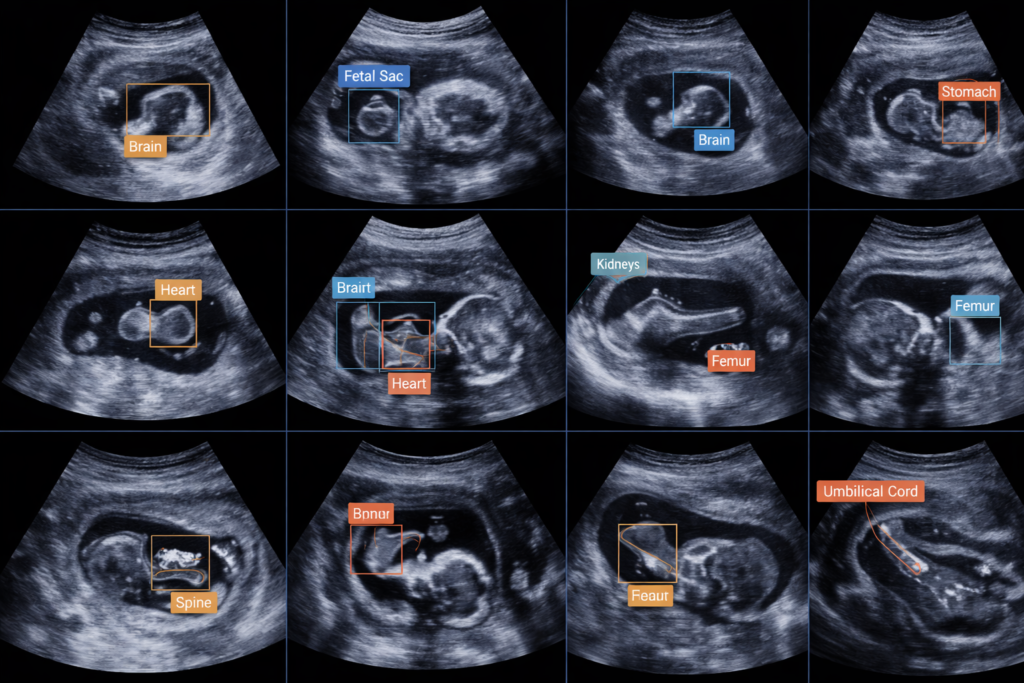
Organ-level pixel segmentation for:
Brain & skull
Spine & vertebrae
Abdomen & femur
Heart chambers
Bounding box tagging for anomaly-prone zones
Temporal frame-by-frame abnormality labeling for ultrasound video clips
Multi-Layer Quality Assurance
| QA Stage | Validation Method |
|---|---|
| Level 1 | Peer review by trained medical annotators |
| Level 2 | Clinical rule-based verification checks |
| Level 3 | Automated anomaly detection for edge-cases |
Security & Compliance
HIPAA-aligned encrypted data pipelines
NDA-protected dataset access
Continuous audit logs for traceability
Project Impact
| KPI | Before Dserve AI | After Dserve AI |
|---|---|---|
| Detection Precision | 73% | 94.1% |
| Inter-Annotator Agreement | 68% | 98.6% |
| Annotation Rework Rate | 21% | 2.5% |
| Dataset Turnaround Time | 5 weeks | 1.8 weeks |
| False Positive Rate | High | Reduced by 52% |
Business Outcomes
The implementation of Dserve AI’s high-quality, clinically validated ultrasound dataset translated into tangible business results for the client. By providing reliable, ready-to-train data, the client was able to accelerate AI development, reduce operational overhead, and improve trust with clinical partners. These outcomes helped the client achieve faster adoption and better performance for their prenatal screening solution.
Faster AI deployment across pilot hospitals
Reduced retraining cycles and annotation costs
Higher clinician confidence due to improved dataset reliability
Accelerated regulatory validation timelines
detection accuracy
Dserve AI delivered highly accurate ultrasound annotations that improved our AI model’s performance. Their expertise and reliable workflow made dataset preparation seamless and efficient.
– Dr. Rhea Kapoor, CTO, MedTech AI Solutions
Why Dserve AI?
Dserve AI delivers high-quality healthcare datasets that are accurate, consistent, and ready for AI training. Our medical domain expertise, custom labeling protocols, and scalable workflows ensure your AI models perform reliably.
Medical Domain Expertise: Annotators trained in healthcare imaging
Custom Labeling Protocols: Designed for your project’s specific needs
Scalability: Handles large volumes without compromising quality
Data Security: HIPAA-compliant and fully secure
Get Your Healthcare AI Datasets
Access ready-to-train X-ray, CT scan, and ultrasound datasets with expert annotations.
Fill the Dataset Request Form to receive a tailored sample dataset aligned with your AI goals. Build accurate and reliable models faster with Dserve AI.
Request Your Healthcare AI Dataset
Get access to expert-annotated medical datasets to evaluate quality, accuracy, and clinical relevance before starting your project. Submit the form and our team will share curated lung X-ray samples along with dataset documentation.






 Talk to our healthcare AI experts
 Medical expert annotations