


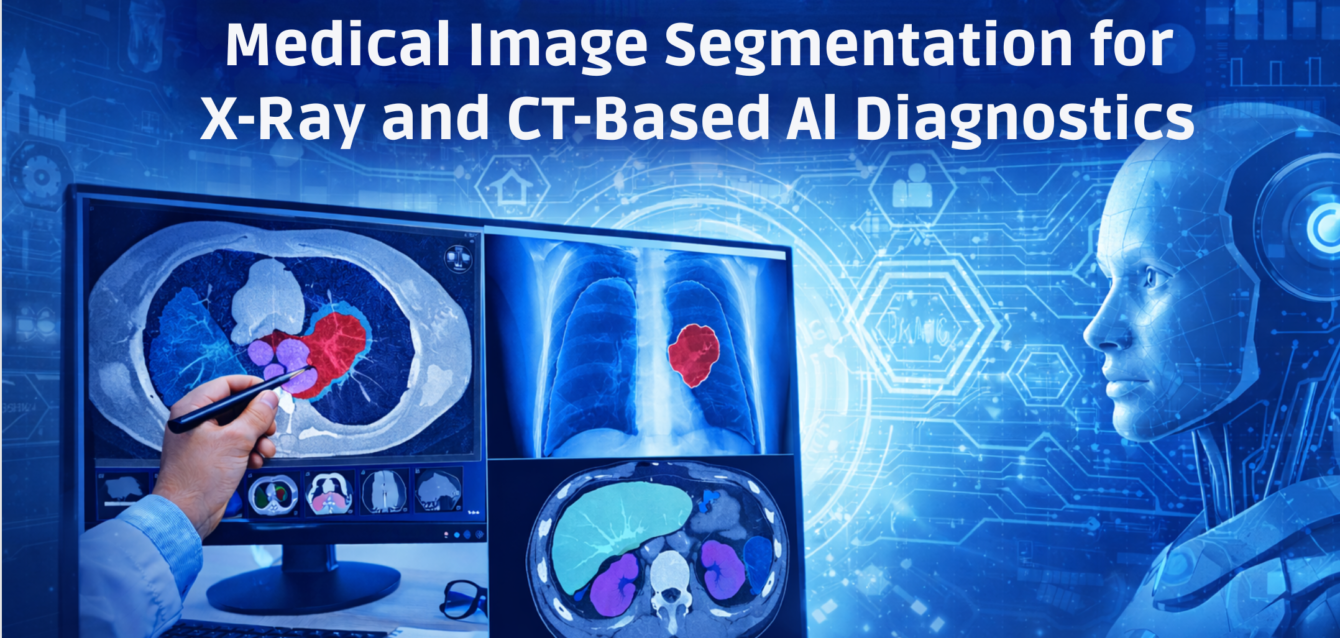
Medical Image Segmentation for X-Ray and CT-Based AI Diagnostics
The client is a US-based healthcare AI company specializing in AI-powered diagnostic solutions for radiology and clinical decision support. Their platforms assist hospitals and diagnostic centers in detecting diseases from X-ray and CT scans with higher accuracy and speed. To improve model performance and ensure clinical reliability, the client required high-quality, precisely segmented medical imaging datasets.
Project Objective
The primary objective of this project was to build a robust, clinically accurate medical image segmentation dataset that could be used to train and validate AI models for X-ray and CT-based diagnostics.
Key objectives included:
Create pixel-level segmentation for X-ray and CT images
Improve accuracy of organ and abnormality detection
Reduce false positives and false negatives in AI diagnostics
Ensure consistency, scalability, and compliance in medical annotations
Enable faster AI deployment in real-world healthcare environments
Key Challenges
Medical image segmentation presents unique technical and clinical challenges that directly impact AI performance.
| Challenge | Description |
|---|---|
| Complex anatomy | Overlapping organs and subtle tissue boundaries in X-ray and CT scans |
| High annotation precision | Requirement for pixel-level accuracy for clinical use cases |
| Data variability | Variations in imaging quality, resolution, and patient demographics |
| Annotation consistency | Maintaining uniform labeling standards across large datasets |
| Data privacy & compliance | Strict adherence to medical data security and de-identification standards |
Our Solution
Dserve AI designed and executed a scalable, quality-driven medical image annotation pipeline tailored for healthcare AI applications.
Our approach included:
Semantic and instance segmentation for organs and abnormalities
Mask- and contour-based annotations for pixel-level precision
Expert-led annotation following radiology-aligned guidelines
Multi-stage quality control and validation workflows
Secure data handling with full de-identification compliance
Project Impact
The segmented datasets significantly enhanced the client’s AI model performance and diagnostic reliability.
| Impact Area | Result |
|---|---|
| Segmentation accuracy | 30–40% improvement over baseline datasets |
| Model reliability | Reduced false positives and diagnostic errors |
| Workflow efficiency | Faster model training and validation cycles |
| Clinical usability | Improved trust in AI-assisted diagnostics |
| Scalability | Enabled deployment across multiple healthcare environments |
Business Outcomes
The project delivered measurable value for the client’s AI and business goals.
Business benefits achieved:
Accelerated time-to-market for AI diagnostic solutions
Reduced dependency on manual image interpretation
Improved customer adoption due to higher diagnostic accuracy
Scalable data pipeline supporting future AI use cases
Strengthened compliance posture for healthcare clients
Dserve AI delivered exceptionally accurate medical image segmentation with strong attention to clinical detail. Their quality assurance process and domain understanding significantly improved our AI model performance.
— Dr. Michael Anderson, Director of AI Research, USA
Why Dserve AI?
Proven expertise in medical image annotation and segmentation
Scalable Data-as-a-Service (DaaS) delivery model
Expert annotators with domain-specific training
Strict quality control and compliance-driven workflows
Trusted partner for global AI and healthcare companies
Get Your Healthcare AI Datasets
Looking to improve your AI model with high-quality medical datasets?
Request a sample medical image segmentation dataset tailored to your use case.
👉 Dataset Request Form
Share your requirements and our team will get in touch with a customized solution.
Request Your AI Dataset
Get access to expert-annotated datasets to evaluate quality, accuracy, and clinical relevance before starting your project. Submit the form and our team will share curated samples along with dataset documentation.






 Talk to our healthcare AI experts
 Medical expert annotations