


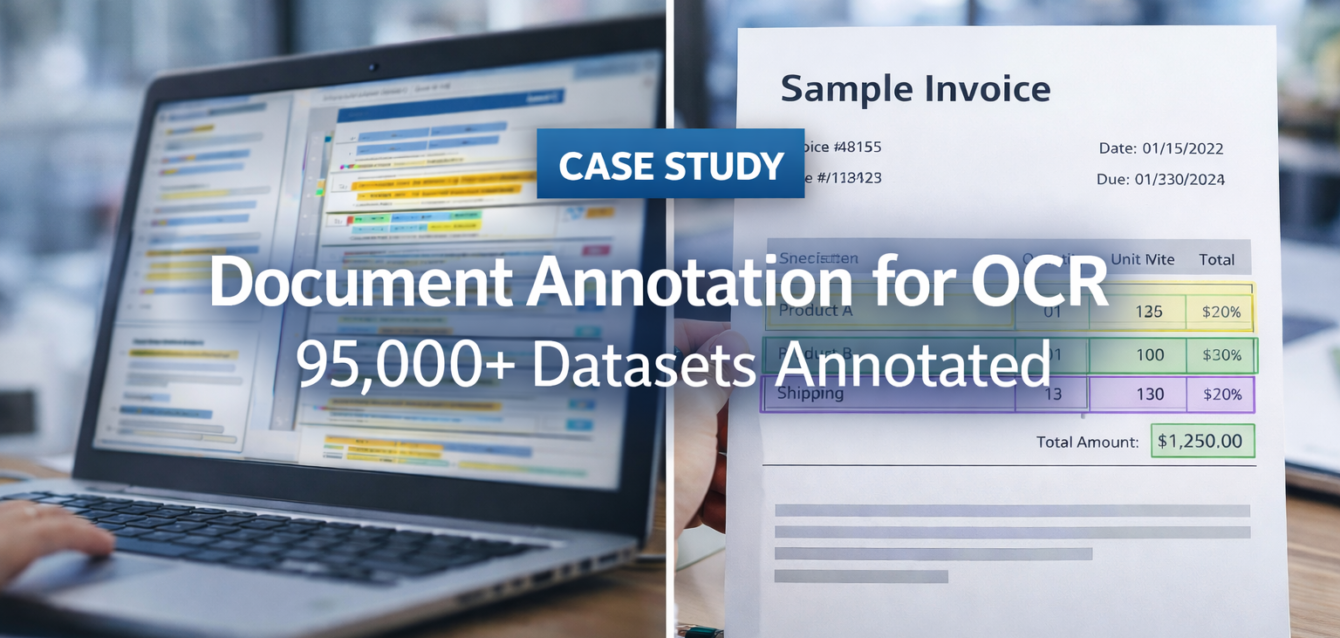
Document Annotation for OCR: 95,000+ Datasets That Boost Accuracy
A leading US-based AI solutions provider partnered with Dserve AI to enhance its OCR capabilities. The client was handling large volumes of documents, including invoices, forms, and reports. However, their existing system struggled with low accuracy and inconsistent data extraction.
Therefore, they required high-quality Document Annotation for OCR to train a more reliable and scalable AI model.
Project Objective
The primary objective was to improve OCR performance using structured and high-quality annotated datasets.
In addition, the client aimed to:
- Increase text recognition accuracy across multiple formats
- Reduce manual data entry efforts
- Improve extraction from complex document layouts
- Build a scalable dataset for continuous AI training
As a result, Document Annotation for OCR became the core focus of the project.
Key Challenges
The project involved several challenges. First, document formats varied significantly. Moreover, data quality was inconsistent. As a result, maintaining accuracy at scale was difficult.
| Challenge | Description |
|---|---|
| Complex Layouts | Documents included tables, multi-columns, and nested structures |
| Low-Quality Scans | Blurred and distorted images reduced OCR readability |
| Data Diversity | Multiple document types required consistent annotation standards |
| Scalability | 95,000+ datasets needed to be annotated without quality loss |
Our Solution
To overcome these challenges, Dserve AI implemented a structured approach to Document Annotation for OCR. First, we standardized the dataset. Then, we ensured consistent annotation across all document types.
Our approach included:
- Data cleaning and preprocessing for better clarity
- Creation of detailed annotation guidelines
- Multi-level annotation (text, layout, tables, key-value pairs)
- Dedicated QA team for multi-stage quality checks
- Scalable workflows to handle large volumes efficiently
As a result, we delivered high-quality annotated datasets within the required timeline.


Project Impact
The impact of structured Document Annotation for OCR was significant. Not only did accuracy improve, but processing speed also increased.
| Metric | Improvement |
|---|---|
| OCR Accuracy | Increased up to 99% |
| Error Rate | Reduced significantly |
| Processing Speed | Improved by 40% |
| Data Consistency | Achieved high standardization |
Business Outcomes
The client experienced measurable business benefits. As a result, their operations became more efficient and scalable.
- Reduced manual data entry costs
- Faster document processing workflows
- Improved AI model performance
- Enhanced customer experience
- Scalable OCR system for future growth
Dserve AI delivered exactly what we needed. The quality of Document Annotation for OCR exceeded our expectations, and the improvement in accuracy was remarkable.
— Michael Anderson, Head of AI Solutions
Why Dserve AI?
Dserve AI stands out for delivering reliable and scalable data solutions.
- Expertise in Document Annotation for OCR
- High-quality, human-in-the-loop annotation
- Scalable team for large datasets
- Strict quality assurance processes
- Fast turnaround time
Get Your Dataset Sample
Want to see the quality before you commit?
👉 Request a sample dataset today: https://dserveai.com/datasets/
Request Your AI Dataset
Get access to expert-annotated datasets to evaluate quality, accuracy, and clinical relevance before starting your project. Submit the form and our team will share curated samples along with dataset documentation.
Everything you need to know about
Document Annotation for OCR involves labeling text, layout, and structure in documents. This helps AI models accurately extract and understand information.
Without proper annotation, OCR systems struggle with complex layouts. Therefore, structured data improves performance significantly.
Invoices, forms, reports, and handwritten notes can all be annotated for OCR systems.
We use detailed guidelines, expert annotators, and multiple quality checks to ensure accuracy.
Yes, datasets can be tailored based on specific business needs and use cases.





 Talk to our healthcare AI experts
 Medical expert annotations