


Delivering 80,000+ Radiology Data Annotation Datasets for AI Diagnosis Systems
A healthcare AI organization specializing in medical imaging solutions required high-quality radiology data annotation to develop advanced AI models for disease detection. Their goal was to enhance diagnostic accuracy using well-structured and precisely labeled radiology datasets, including X-rays, CT scans, and MRI images.
Project Objective
The primary objective was to build a scalable pipeline for radiology data annotation to support accurate and efficient AI diagnosis systems.
Key objectives included:
- Develop a large-scale radiology data annotation workflow
- Accurately annotate complex medical images
- Improve AI model performance with structured datasets
- Reduce model training time
- Ensure scalability for future data requirements
Key Challenges
Executing radiology data annotation at scale involved several critical challenges:
| Challenge | Description |
|---|---|
| Complex Medical Data | Radiology data annotation requires expert-level understanding of medical imaging |
| High Accuracy Needs | Small errors in annotation can impact AI diagnosis results |
| Large Dataset Volume | Managing and processing 80,000+ datasets efficiently |
| Compliance Requirements | Maintaining strict healthcare data privacy standards |
| Annotation Consistency | Ensuring uniform radiology data annotation across datasets |
Our Solution
Dserve AI designed and implemented a robust radiology data annotation pipeline tailored for healthcare AI applications.
Our approach included:
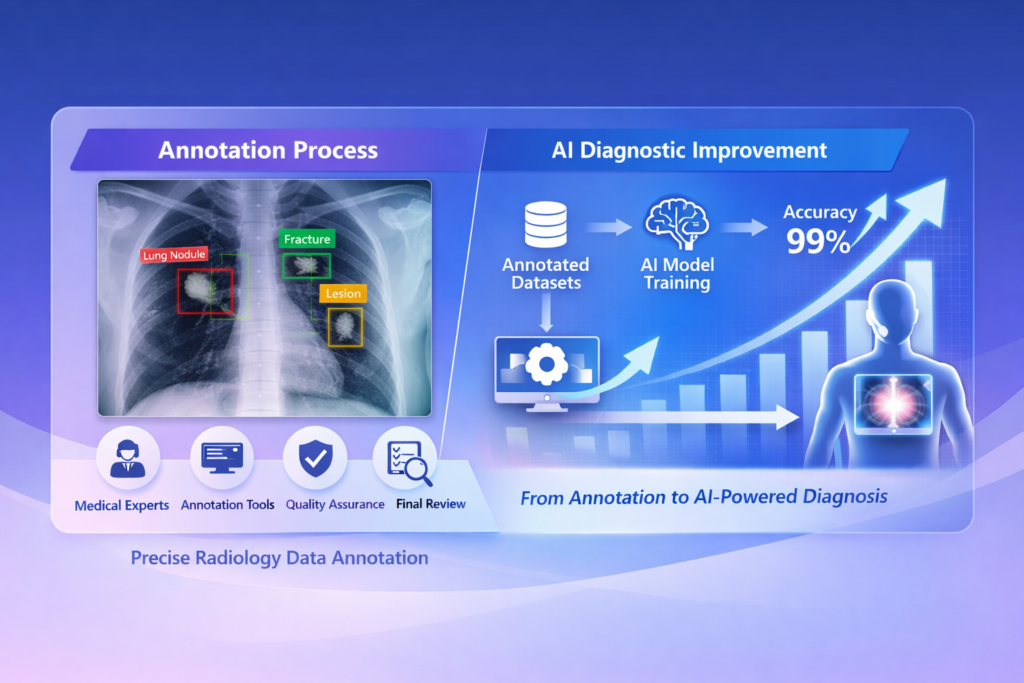
- Deployment of trained annotators for radiology data annotation
- Multi-level quality assurance to ensure high accuracy
- Standardized annotation guidelines for consistency
- Use of advanced tools for precise medical image labeling
- Continuous feedback loops for quality improvement
We successfully delivered 80,000+ radiology data annotation datasets, ensuring high-quality outputs across multiple imaging formats.
Project Impact
Our radiology data annotation services significantly enhanced the AI model’s performance:
| Metric | Impact |
|---|---|
| Annotation Accuracy | Achieved 99% precision |
| Model Performance | Significant improvement in diagnosis accuracy |
| Processing Speed | Faster AI training cycles |
| Data Consistency | Uniform annotation across datasets |
| Scalability | Enabled seamless future expansion |
Business Outcomes
Through high-quality radiology data annotation, the project achieved strong business and technical outcomes.
Key outcomes:
- Reduced time-to-market for AI deployment
- Improved reliability of diagnostic systems
- Scalable and future-ready data pipeline
- Enhanced confidence in AI-driven healthcare solutions
The quality of radiology data annotation delivered exceeded expectations. The structured process and attention to detail significantly improved our AI model performance.
Dr. Sarah Thompson, Director of Medical AI
Why Dserve AI?
- Expertise in radiology data annotation
- High accuracy with multi-layer QA process
- Proven experience with large-scale datasets
- Scalable and customized solutions
- Fast turnaround with consistent quality
Get Your Dataset Sample
Looking for reliable radiology data annotation services?
Request your sample dataset today
👉 Start Your Radiology Data Annotation Project
Request Your AI Dataset
Get access to expert-annotated datasets to evaluate quality, accuracy, and clinical relevance before starting your project. Submit the form and our team will share curated samples along with dataset documentation.
Everything you need to know about
Radiology data annotation is the process of labeling medical images such as X-rays, CT scans, and MRIs to train AI models for accurate disease detection and diagnosis.
Radiology data annotation is essential because AI models rely on high-quality labeled data to learn patterns. Accurate annotation directly improves diagnosis accuracy and model performance.
Radiology data annotation includes labeling various medical images such as:
- X-rays
- CT scans
- MRI scans
- Ultrasound images
High-quality radiology data annotation should achieve near-perfect accuracy (typically 95–99%) because even small errors can impact AI diagnosis outcomes.
Radiology data annotation improves AI by providing structured, labeled datasets that help models detect patterns, leading to better accuracy, faster training, and reliable diagnostic results.






 Talk to our healthcare AI experts
 Medical expert annotations