


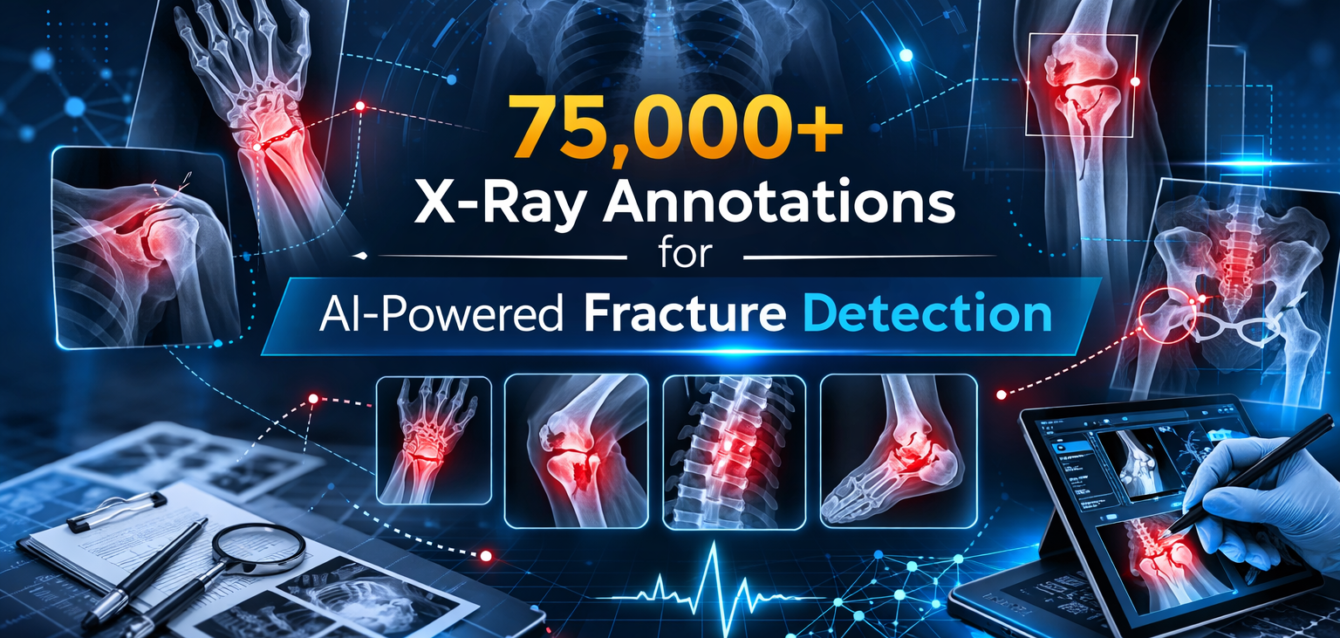
75,000+ X-Ray Annotations for AI-Powered Fracture Detection
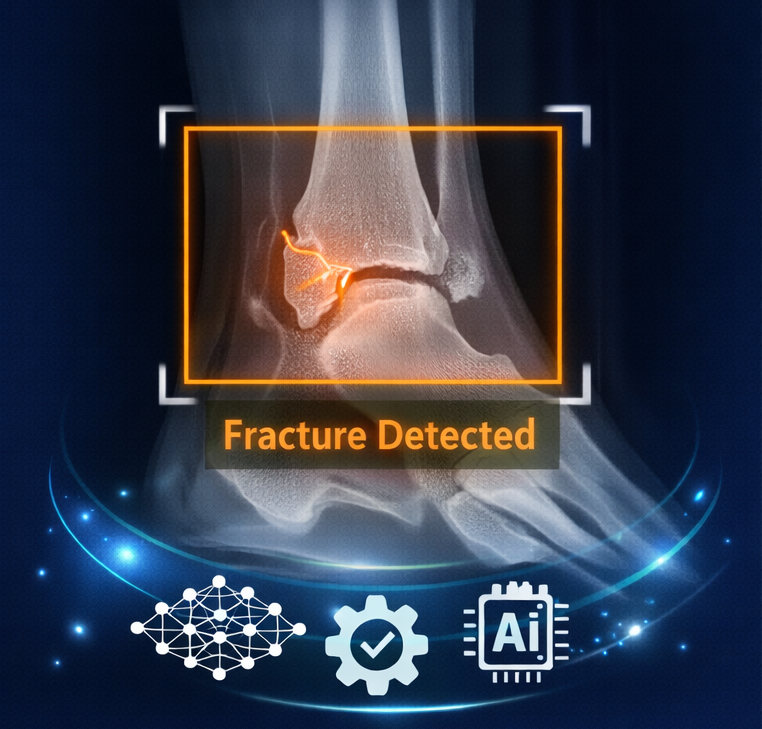
A US-based healthcare AI company, develops artificial intelligence models that assist radiologists in detecting bone fractures from X-ray images.
The company works with hospitals and emergency care centers where fast and accurate diagnosis is critical. However, their AI model struggled to detect subtle fractures. Therefore, they partnered with Dserve AI to build a large, high-quality annotated dataset to improve model performance.
Project Objective
The main goal was to create a structured dataset of 75,000+ annotated X-ray images covering multiple fracture types and body regions.
In addition, the client wanted consistent annotation standards and strong quality validation.
Key Objectives
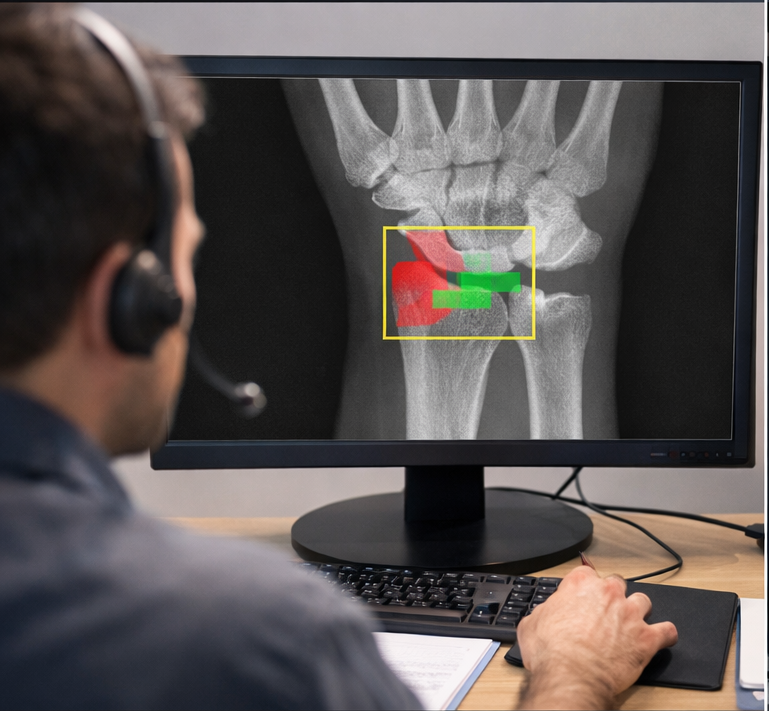
Pixel-level fracture segmentation
Bounding box labeling for localization
Classification of fracture types
Multi-anatomy coverage (wrist, ankle, ribs, spine, clavicle)
HIPAA-compliant data handling
Double-layer quality assurance
Key Challenges
Although the project scope was clear, several challenges affected model accuracy and data consistency. First, many fractures were extremely subtle. Hairline fractures, in particular, were difficult to identify even for trained professionals.
Second, different radiologists sometimes marked fracture boundaries differently. As a result, annotation consistency became a concern. Moreover, image quality varied significantly. Portable X-rays from emergency rooms often had lower contrast and higher noise.
Finally, strict healthcare compliance requirements required secure data handling and PHI removal.
Challenges Overview
| Challenge | Impact |
|---|---|
| Subtle hairline fractures | High false negatives |
| Annotation inconsistency | Model confusion |
| Image quality variation | Reduced training stability |
| Multi-region dataset | Complex workflow management |
| Data privacy compliance | Additional validation layers |
Our Solution
To address these challenges, Dserve AI designed a structured and scalable annotation workflow.
First, we implemented AI-assisted pre-labeling to speed up the process. Then, certified medical annotators refined the annotations. After that, radiologists conducted double-blind validation to ensure precision.
In addition, we standardized annotation guidelines to reduce variability. This step significantly improved labeling consistency across anatomy types.
Furthermore, we integrated automated PHI detection tools to ensure HIPAA compliance.
Implementation Approach
AI-assisted pre-annotation
Expert human refinement
Radiologist consensus validation
Standardized annotation protocol
Automated PHI detection and removal
Structured dataset formatting for ML pipelines
Project Impact
As a result of structured annotation and validation, the model’s performance improved significantly.
Not only did detection accuracy increase, but false negatives also decreased. Moreover, model training became faster due to clean and consistent data.
Performance Improvements
| Metric | Before | After Dserve AI |
|---|---|---|
| Detection Accuracy | 82% | 94% |
| False Negative Rate | 18% | 7% |
| Training Time | 6 weeks | 4 weeks |
| Annotation Disagreement | High | Reduced by 35% |
Business Outcomes
Because of improved model reliability, the client accelerated product deployment in partner hospitals.
Additionally, investor confidence increased due to stronger validation metrics. Most importantly, hospitals reported better emergency workflow efficiency.
Business Benefits
Faster regulatory documentation support
Increased hospital adoption
Reduced medico-legal risk
Improved ER triage efficiency
Stronger market positioning
"Dserve AI delivered consistent and high-quality annotations at scale. Their structured validation process directly improved our fracture detection accuracy."
— Head of AI Research (USA)
Why Dserve AI?
Dserve AI combines medical expertise with scalable AI workflows.
Moreover, our team follows strict compliance standards while maintaining fast turnaround times. Therefore, clients receive reliable datasets that are ready for production AI systems.
Our Strengths:
- Medical-domain trained annotators
- Radiologist-in-the-loop validation
- HIPAA & GDPR-compliant workflows
- Multi-layer quality assurance
- Scalable dataset production
- Custom ML-ready formatting
Get Your Healthcare AI Datasets
Are you building an AI model for medical imaging?
Request a sample dataset tailored to your requirements.
Dataset Request Form
Please share:
Dataset type (X-ray, CT, MRI, Ultrasound)
Annotation type (Segmentation, Bounding Box, Classification)
Required volume
Compliance requirements
Deployment region
📩 Contact Dserve AI today and receive your custom dataset sample within 48 hours.
Request Your AI Dataset
Get access to expert-annotated datasets to evaluate quality, accuracy, and clinical relevance before starting your project. Submit the form and our team will share curated samples along with dataset documentation.





 Talk to our healthcare AI experts
 Medical expert annotations