


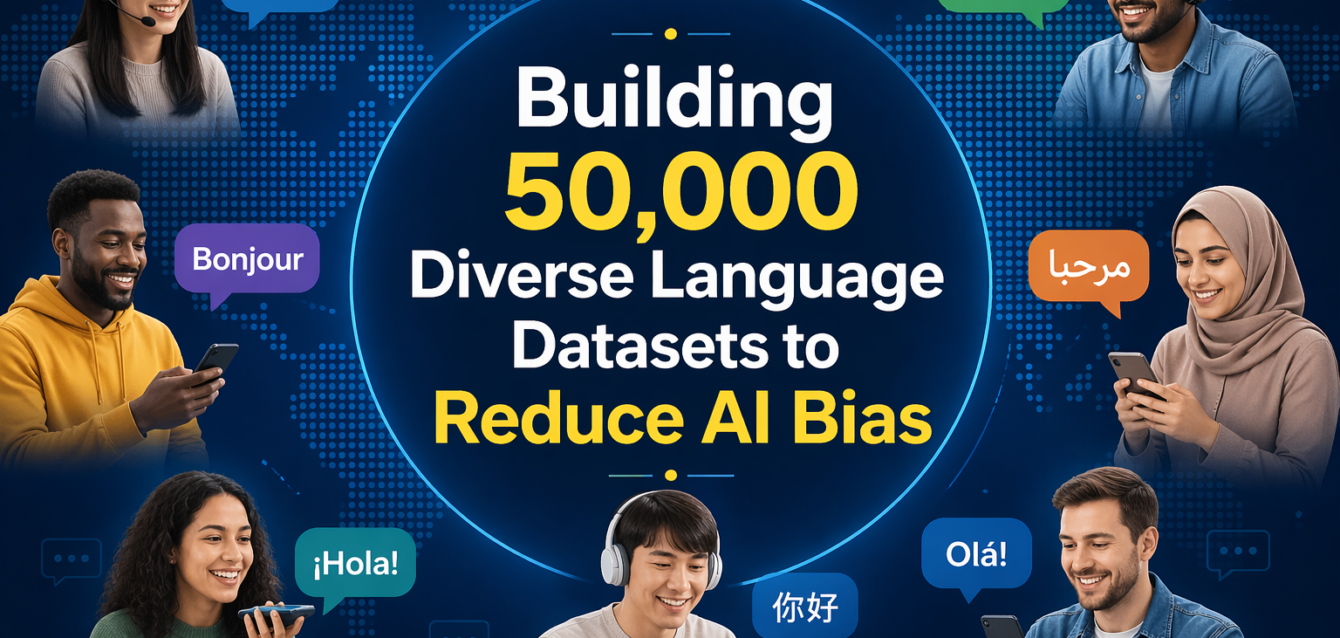
Building 50,000 Diverse Language Datasets to Reduce AI Bias
Artificial Intelligence systems are only as strong as the data used to train them. When language datasets lack diversity, AI models often favor dominant languages, accents, and communication styles. This creates bias, poor user experiences, and reduced performance in global markets.
Dserve AI worked with a fast-growing technology client to solve this issue by building 50,000 diverse language datasets across multiple demographics, geographies, and speaking styles. The objective was to improve fairness, multilingual understanding, and model accuracy at scale.
Client Background
The client was developing an AI-powered conversational platform used for:
- Customer support automation
- Virtual assistants
- Multilingual chatbots
- Sentiment analysis
- Voice-to-text applications
- Intent detection systems
As their user base expanded internationally, their existing AI model started facing serious language bias challenges.
Key Challenges
The client’s existing datasets were heavily concentrated around standard English and a few mainstream language sources. This created multiple problems:
1. Accent Bias
The model struggled to understand users with regional pronunciations or non-native accents.
2. Poor Multilingual Accuracy
Responses were inconsistent when users switched between languages in the same sentence.
3. Low Context Understanding
Local expressions, slang, and cultural phrases were often misunderstood.
4. Unfair User Experience
Users from underrepresented communities experienced lower-quality interactions.
5. Market Expansion Delays
Launching in new regions required rebuilding datasets from scratch.
Dserve AI Strategy
Dserve AI created a fully managed dataset development workflow to build balanced, accurate, and scalable language data for training modern NLP systems.
Project Scope
Total Dataset Volume:
50,000 curated language datasets
Languages Covered:
- English (US, UK, India, Australia)
- Hindi
- Marathi
- Tamil
- Telugu
- Bengali
- Gujarati
- Arabic
- Spanish
- French
Additional Diversity Factors:
- Urban and rural speakers
- Male and female voices
- Different age groups
- Formal and casual communication styles
- Code-mixed conversations
- Industry-specific terminology
Dataset Types Delivered
Dserve AI created multiple dataset categories to improve model intelligence:
Text Datasets
- Customer chats
- FAQs
- Support tickets
- Search queries
- Regional phrases
Speech Datasets
- Accent-rich audio samples
- Noisy environment recordings
- Call center conversations
- Natural speech pauses and fillers
Annotation Datasets
- Sentiment labels
- Intent classification
- Named entity recognition
- Topic tagging
- Toxicity moderation labels
Quality Control Framework
Every dataset passed through a multi-stage validation pipeline.
Quality Steps Included:
- Human annotation review
- Native speaker verification
- Duplicate data removal
- Bias and imbalance checks
- Accuracy scoring
- Random sample audits
- Final enterprise QA approval
This ensured the client received production-ready data with consistent standards.
Results Achieved
After retraining the AI model using Dserve AI datasets, the client reported measurable improvements:
Performance Gains
- 34% increase in multilingual response accuracy
- 29% reduction in biased outputs
- 41% improvement in intent recognition
- 37% better sentiment detection for regional language content
- Faster onboarding for new markets
Business Impact
- Improved customer trust
- Higher chatbot satisfaction scores
- Reduced escalation to human agents
- Lower retraining costs
- Better retention in multilingual user segments
Why Diverse Language Data Reduces AI Bias
Bias often happens when models learn from limited sources. Diverse datasets expose AI systems to real-world communication patterns.
Benefits Include:
- Better fairness across communities
- Stronger regional understanding
- Improved accessibility
- Accurate responses for mixed-language users
- Inclusive user experiences
- Higher global adoption rates
Why Businesses Choose Dserve AI
Dserve AI helps organizations build custom datasets for enterprise AI growth.
Our Expertise:
- Data Collection
- Data Annotation
- NLP Datasets
- Speech Data Creation
- Computer Vision Datasets
- Healthcare AI Data
- Generative AI Fine-tuning Data
- Bias Reduction Projects
Why Clients Trust Us:
- Scalable operations
- Fast turnaround time
- Human-in-the-loop quality checks
- Custom project workflows
- Secure data handling
Future Opportunities for the Client
With the new data foundation, the client can now expand into:
- Voice assistants for regional markets
- Multilingual customer support bots
- AI search tools
- Smart IVR systems
- Localized recommendation engines
Need Custom Language Datasets?
If your AI product struggles with bias, poor multilingual performance, or inaccurate responses, Dserve AI can build high-quality custom datasets tailored to your model goals.
Build smarter and fairer AI with Dserve AI.
Visit: https://dserveai.com/
Request Your AI Dataset
Get access to expert-annotated datasets to evaluate quality, accuracy, and clinical relevance before starting your project. Submit the form and our team will share curated samples along with dataset documentation.
Everything you need to know about
Custom AI datasets for enterprise automation are structured and tailored data used to train AI models for automating business processes like document handling, customer support, and workflow optimization.
Custom datasets ensure higher accuracy and relevance. As a result, AI models perform better because they are trained on data specific to business needs.
Industries such as healthcare, finance, retail, logistics, and customer service benefit greatly from custom AI datasets for automation.
Dserve AI follows strict quality checks, annotation guidelines, and multi-level validation processes to deliver accurate and reliable datasets.
Yes, custom AI datasets can be scaled efficiently. With the right workflow and team, large volumes of data can be processed without compromising quality.





 Talk to our healthcare AI experts
 Medical expert annotations